Banking and finance
Group 1
Bank robberies: What to do in a bank robbery?
Since the credit-crises bank robbing isn’t a lucrative job anymore.
One of the reasons is that bank robbers have to invest a lot when they want to rob a bank, from a pistol to powerful drugs.
Banks give their employees training about how to act when a bank robbery is in progress, but the latest weeks the banks are robbed by the managers themselves.
After the bank robbery , the worst is yet to come, victims can feel very shocked or they can be very happy they’re still alive, but most of the people have various feelings.
http://banking.about.com/securityand safety/a/bankrobbery.htm
Ruben Den Ticht
zondag 26 oktober 2008
donderdag 23 oktober 2008
Eat this, Bill!

All around the world, people lost fortunes in the last few weeks. One of them is the famous Bill Gates, who now owns 1,1 billion dollars less than before the crisis. But not everyone lost money: the legendary investor Warren Buffett, CEO of Berkshire Hathaway added 8 billion dollars to his already bulging wallet, which is now estimated at a whopping 58 billion dollars.
Bill Gates can say goodbye to his title, Warren has lately been crowned the richest person in the USA.
Hannelore Dekoning
group 1
bronnen: http://www.tijd.be/nieuws/wijde_wereld/Warren_Buffett_is_rijker_dan_Bill_Gates.8089414-603.art
zaterdag 18 oktober 2008
'Safe' your money
The modern man nowadays is saving his money on an old-fashioned way, this due to the fear of losing his own savings which are administered by big banks such as Dexia and Fortis.
Although the money is safe on a bank account, people nowadays choose to manage their own money.At present, enterprises selling lockers are pleased with the fincial crisis because the sales of hawse-holes has been increased enormously lately.
The people who caused this increase are mostly the erlder people who are scared to loose their possessions, they simply don't believe banks are able to take care of their money in hard times like these.
Michiel De Baere
bron: http://www.standaard.be/Artikel/Detail.aspx?artikelId=G7B21NFPU&word=kluizen
Although the money is safe on a bank account, people nowadays choose to manage their own money.At present, enterprises selling lockers are pleased with the fincial crisis because the sales of hawse-holes has been increased enormously lately.
The people who caused this increase are mostly the erlder people who are scared to loose their possessions, they simply don't believe banks are able to take care of their money in hard times like these.
Michiel De Baere
bron: http://www.standaard.be/Artikel/Detail.aspx?artikelId=G7B21NFPU&word=kluizen
woensdag 15 oktober 2008
Rescue plan : What's in it?
Rescue plan : What's in it?
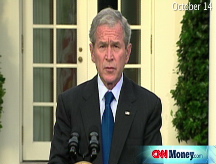
The federal government of the United States of America announced a plan to restore confidence in the U.S. financial system.
The measurements exist of 4 key points.
The government is planning to buy equity in banks while their backing debts of new banks. The FDIC will temporarily provide coverage for bank deposits. Aside from this the Federal Reserve is going to buy short-term commercial paper to spur banks to begin lending against a normal rate.
Source : Money CNN

Michael Bynens
The federal government of the United States of America announced a plan to restore confidence in the U.S. financial system.
The measurements exist of 4 key points.
The government is planning to buy equity in banks while their backing debts of new banks. The FDIC will temporarily provide coverage for bank deposits. Aside from this the Federal Reserve is going to buy short-term commercial paper to spur banks to begin lending against a normal rate.
Source : Money CNN
Michael Bynens
dinsdag 14 oktober 2008
Bush & Paulson: rescue rangers?

The With House announced Tuesday that it will partially nationalise the biggest banks of the US. In exchange, Washington would receive stocks of those banks and should control more their expenses. This measure (250 billion), part of the 700-billion ‘Paulson-Plan’, could help to stabilise the financial system and recover the (world) economy. The With House and Joe Sixpack have to wait for another couple of months, whether this action and all other actions in the past months will help.
Emmanuel Caudron
The Times(online), Wednesday July 16 2008
There is no such thing as free banking

A study from the Office of Fair Trading said the current account market is not working well for customers. It is very difficult for clients to compare their account with others due the lack of information. Because the complexity of fees and an uncompetitive market clients aren’t able to choose the best deal. That is why The OFT wants to talk with banks and consumer groups to try to achieve greater clarity, transparency and consumer empowerment in this market. The comment of British Bankers' Association (BBA) said the report had only looked at revenue and not considered the cost of running a current account.
Pieter De Bakker
link: Guardian, Wednesday July 16 2008
Lost your appetite?

While the shareholders of Fortis are digging deep into their pockets to feed their families worried about the value of their shares, the Belgian bank could afford an extravagant trip to Monaco last Friday. On this ‘business’-trip members of Fortis Insurance Belgium wanted to spoil some external insurance agents with a visit to one of Monaco’s most prestigious restaurants with three Michelin-stars, an incentive that cost more than 150.000 euros and caused a wave of protests in the Belgian political world and among their shareholders. The company justified the commercial action by saying the event had been planned months beforehand as part of their business strategy, but now admits the timing wasn’t exactly right. Loyal shareholders would have been satisfied to share this decadent experience, unfortunately, they couldn’t have a bite.
Katrien Cailliau
De Standaard Saturday October 11 2008
savers protection

The Belgian government has taken action to protect savers. The protection of deposits will probably be raised from 20 000 euro to 100 000 euro, which will give the savers back their confidence. Not only will the protection of deposits be raised, the number of organisations that is obliged to participate will also be raised, for instance insurance companies and companies delivering similar products. To carry these protections through, a fund will be raised and all participating organisations will have to join it.
lucie debouver
Number of mortgages hits record low
Nowadays, everyone knows the economy has seen better days, certainly because the effects of the approaching recession are noticeable everywhere, especially in the mortgage market. Because of the crisis, people like to wait rather than to borrow and buy a house immediately, which results in a demand for houses that is going down, and so are the house prices. In August, there was already a record low of people who borrowed money to purchase a house and the average value of loans is also decreasing, which means a drop of 42% of the total value of mortgage compared to August 2007. As the house market is on the decline, it will be difficult to regain the confidence of prospective buyers and improve the number of mortgages again.
Bieke Clicque
Bieke Clicque
How t

There has been an evolution in the relationship between grandparents and grandchildren. Grandparents are responsible for the future career of their grandchildren. It is their duty to be in charge of the tuition fees of their grandchildren, it is supposed to be better than spoiling them with all kind of sweets...The main reason given for this point of view is that parents are not capable of saving enough to give their children a good education and the children themselves aren’t either. These facts make it for many people very clear that it are the grandparents, who have saved a lot, should be supporting their family financially.
Tine Vandewalle
http://www.northernstar.info/article/4544/
Stereotypes?

With the recent separation of Fortis, the stereotypes of ‘stupid’ Belgians and ‘greedy’ Dutchmen have once again been confirmed. When Fortis took over ABN AMRO, this was much against the likes of the Dutch and until recently it was unclear why Fortis was forced to pay to own the name ‘ABN AMRO’. Now, after the separation, it is obvious why the Dutch were so keen on this: the name would be useful when Fortis Belgium and Fortis Netherlands were separated (again). Once again the Dutch managed to put all the profits into their own pockets while the Belgians are cheated and left behind with huge debts and other (unsolvable) problems.
Anne Ceulebrouck
Credit/debit-card fraud: still no end in sight!

Credit/debit-card fraud seems to be a determined problem.
However certain protections, such as Pin codes, have diminished the fraud, criminals are getting more creative by focusing their energy on new methods. The most popular way nowadays: the fraudsters direct unaware consumers to fake cash machines, once the victim has inserted his card the machine makes an exact copy of it.
Another booming method of credit/debit-card fraud is the internet: by sending false emails fraudsters try to obtain consumers’ card details.
Liesbeth Debusschere
However certain protections, such as Pin codes, have diminished the fraud, criminals are getting more creative by focusing their energy on new methods. The most popular way nowadays: the fraudsters direct unaware consumers to fake cash machines, once the victim has inserted his card the machine makes an exact copy of it.

Another booming method of credit/debit-card fraud is the internet: by sending false emails fraudsters try to obtain consumers’ card details.
Liesbeth Debusschere
Last man standing?

For now Chinese banks seem to resist the global financial crisis. Compared to American banks, the Chinese should resist far better against the falling house prices, because in China a mortgage is insured by a minimum deposit of 20-40%. In the second place the riskier loans to property developers are limited to 7% of total bank lending.
It seems the domino effect of the financial crisis will not hit the Chinese banking system as hard as in American en Western Europe.
Matthias Carchon
Source: The Economist - China's economy: domino or dynamo?
The banking crisis overflows into the real economy
If you thought the banking crisis wouldn’t affect the whole economy, you may think again, as already companies are feeling what this crisis means to them; loans are becoming more difficult to obtain and the costs of finance are getting higher for most of the borrowers.
Not only banks are making it more difficult for companies to survive; important customers are paying later whereas suppliers aren’t willing to wait very long for their money.
However, there are some good consequences too; banks are more aware of the risks they are taking when lending, say, ten times a company’s capital. Therefore, they will only lend companies up to two or three times their capital, so that most of them will be able to pay off the debts.
source: http://www.economist.com/research/articlesBySubject/displaystory.cfm?subjectid=348885&story_id=12381942
Liesbeth Cosyn
Not only banks are making it more difficult for companies to survive; important customers are paying later whereas suppliers aren’t willing to wait very long for their money.
However, there are some good consequences too; banks are more aware of the risks they are taking when lending, say, ten times a company’s capital. Therefore, they will only lend companies up to two or three times their capital, so that most of them will be able to pay off the debts.
source: http://www.economist.com/research/articlesBySubject/displaystory.cfm?subjectid=348885&story_id=12381942
Liesbeth Cosyn
Life after death?
As the financial crisis rages through the land we must ask ourselves what will happen to our savings and investments and more importantly what can we do to avoid losses in the future.
In Britain the law secures up to £35,000 of your savings, unfortunately in case the bank goes under the rest of your savings will be lost, assuming the state doesn't intervere.
For investors the situation doesn't look much better as their assets are not secured by the law and they can only watch how the share-prices collapse.
As for what can be done to avoid losses poeple could spread their savings over several banks to minimize the risk and investors tend to reach for so-called "safe havens"-assets such as precious metals, which tend to rise as the value of currencies falls.
Jonathan Colpaert.
In Britain the law secures up to £35,000 of your savings, unfortunately in case the bank goes under the rest of your savings will be lost, assuming the state doesn't intervere.
For investors the situation doesn't look much better as their assets are not secured by the law and they can only watch how the share-prices collapse.
As for what can be done to avoid losses poeple could spread their savings over several banks to minimize the risk and investors tend to reach for so-called "safe havens"-assets such as precious metals, which tend to rise as the value of currencies falls.
Jonathan Colpaert.
Is it just the beginning of a extensive crisis?

The bank bailout should save British banks, but what if a bank rescue doesn’t solve the large economy issue, which is already lasting for a long time now; not only the specialists in finance are worried, but also the man on the street is aware of the money trouble.
It has become much more difficult to obtain a loan, as well as for a company, as for an ordinary citizen and furthermore customers try to postpone their debt servicing as long as possible, however that trick has a bad influence on the rest of the process.
If we may believe the new primary bear market signal from Dow Theory, that started in 2000, we will have to prepare for a much bigger problem than this, which is also indicated by the return to the natural yield gap as equity yields go higher and gilt yields go lower.
That is why there have been a few manifestations and actions, such as strikes against purchasing power,... because people are getting afraid of what the future will bring and they want the whole world to be ready to handle the future troubles.
www.moneyweek.com
Kirkee De Clercq
Football teams do not escape the financial crisis

The worldwide financial crisis controls the news already for 3 straight weeks now, and more and more groups are being confronted with the consequences of this crisis. Some football teams, like West Ham United, even lost their biggest sponsor and are now heading towards bankruptcy. In Liverpool too, there can be spotted a little crisis, because the constructions for the new stadium have been put on “hold”, because their American investors have liquidity problems. Like we feel and see the financial crisis escapes nobody, but let us hope that the sporting activities do not have to pay for the errors the financial world has made.
Steven Braet
Iceland hits rock bottom

Imagine, standing in a queue to withdraw money,
finding out that you can only withdraw 400 euro. That is what happened to thousands of people in the UK and in the Netherlands, who had a deposit account at the Icelandic banc Icesave.
Icesave, is a part of Landsbanki, on of the 3 bancs that faced serious problems caused by the credit crunch in Iceland. Iceland itself has faced enormious difficulties to save their national economy, the Icelandic government remains positive, and insures that the accounts at Icesave are safe; but for the Icelandic people the future, with high inflation, unemployment,… is looking less bright.
Sanne Vandenborre
http://eng.utanrikisraduneyti.is/speeches-and-articles/nr/4500
No risk? Don’t put money in the bank for more than £50,000.
The FSA decided to bring up the guarantee on savings from £35,000 to £50,000 in order to recover the confidence of investors. The confidence disappeared because banks refused to lend to one another, fearing that they would need all their money themselves. Trying to avoid liquidity problems, the Bank of England will now accept a wider range of collateral in exchange for fresh funds. In this way, banks will have access to cash accounts to meet the needs of their clients.
http://www.guardian.co.uk/business/2008/oct/04/bankofenglandgovernor.banking1
Jolien De Baerdemaeker
http://www.guardian.co.uk/business/2008/oct/04/bankofenglandgovernor.banking1
Jolien De Baerdemaeker
A light at the end of the tunnel?

After weeks of financial turmoil on the markets, the governments of the industrialised countries have finally found an effective measure to restore confidence in the financial system, or at least it seems with stockmarkets around the world rising again. The latest measures focus on improving the liquidity position of the banks which can't borrow money on the frozen short-term money-markets and garantueeing the survival of all banks by government participation and garantuee all new bank debts. But is this really the end of weeks of uncertainty in the financial, 2 major weaknesses still remain and will these new measures be effective enough to restore the confidence on the financial markets or will the next setback cause another plummet of shares?
Tim Van Coningsloo
http://www.economist.com/finance/displaystory.cfm?story_id=12408936
Youth is the future...for banks

Youth is the future...for banks
Nowadays banks do everything to attract young people because once they have an account in a certain bank they stay there mostly for the rest of their lives. A bank can offer youngsters several different saving and current accounts, even unborn babies are able to have one. Most of these offers are similar to one another but banks will try to be unique by giving certain presents or promotions to make young clients really want that specific account. A new way to convince our youth is by sponsoring their sporting activities and culture events because in that way they are not even able to forget about banks.
Bostyn jasmine
European financial crisis
The European governments don't really work well together to solve the financial crisis. The president of the EU (Nicolas Sarkozy) organized a top between France, Germany, Britain and Italy but they didn't found any solutions. Some days later all the finance misters of the EU met in Luxemburg because they wanted to raise the minimum deposit insurance to €100,000. But they didn't achieve that goal, the deposit insurance was only raised to €50,000 because the countries in eastern Europe would have difficulties to guarantee €50,000.
Lander Bruneel
http://www.economist.com/world/europe/displaystory.cfm?story_id=12381693
Lander Bruneel
http://www.economist.com/world/europe/displaystory.cfm?story_id=12381693
SOS, Europe needs a plan

A plan to rescue banks from bankruptcy is more than welcome in Europe. Fortis and Dexia, for example, two of europe's big cross-border banks, were rescued at short notice by the Beneluxe with capital injection. A solution for Europe could be to create a single European financiel regulator but France and Germany disagreed. A pan-European rescue plan is not yet for today but hopely soon, because time is money.
Evelyn Demaree
http://www.economist.com/finance/displaystory.cfm?story_id=12342665
Fortis shares resume trading at 77%
Fortis shares have not been traded since last week and started today at 11am at an all time low. Fortis stopped trading shares after BNP Paribas had bought the Belgian banking assets. Shareholders in the mean time had no power of speech and were left to themselves. Moreover, the government measures taken by the Belgian government did not result in more confidence and hence the future of the Fortis shares remains very uncertain.
Olivier Cools
(00700338)
(source: http://afp.google.com/article/ALeqM5hidup3wiqfpB_-9Re3TfUW0u6MFw)
A first stap

For weeks governments have been trying to save their own banks, without wondering if it could damage other banks. Finally you can see a comprehensive global answer to the confidence gap, but it is definitely not enough, more government intervention in the short term is needed. The simple reason being: if they don’t do anything about it together, you will see the output in rich and poor countries collapse. The problem is that it’s not simple to fix this crisis, because it’s a much deeper and broader crisis than the ones we knew before.
Christophe Clara
(source: http://www.economist.com/opinion/displayStory.cfm?source=most_commented&Story_ID=12381429)
What does bad banking news mean to us?

Lately there appeared a lot of bad news about the banking industry, this may have made you wondering about the safety of your hard earned cash at your own bank.
The drop in the bank profits is caused by expected loan losses, the deteriorating housing market and the credit squeeze. According to banking experts only FDIC insurance will save your money if your bank goes under, the FDIC insures deposits in banks and thrift institutions.
But fortunately for all of us, banks are entering this credit cycle with better capital and better earnings, and thanks to this experts say there is no reason to panic.
Emilie Mouton
Bush wants to expand the financial support to the banking system

The government wants to expand the protection of the American banking system. They will use 250 milliard dollar from the financial savings plan to buy shares. Another measure to handle the crisis consists of a temporary strike of the guarantee of saving assets. The minister of finance Paulson has announced “a series of complete measures to reinforce the trust in the American financial system”.
Deman Justine
A ray of hope in crisis

These last few years, the banking sector is playing one of the main parts in wrecking the US economy,so a reaction is bound to come..
Banks are obliged to reduce golden parachute payoffs for departing executives and to limit their bonus schemes in return for help from the US taxpayer.
This has lead to a lot of positive reactions, because during the last decade executives have gained enormous premiums, from $ 35m up to $ 161m!
Could there be a possibility that the crisis will change the obscene culture of self-enrichment?
Celien De Lat
http://www.guardian.co.uk/business/2008/sep/26/wallstreet.useconomy
When will I get my money back?
Around £ 4 billion are frozen on accounts of the failed Icelandic bank Icesave. The 300,000 UK savers deposited their money with that bank because it promessed some of the highest-paying savings accounts in the UK market. The result is now that those people don't know when they'll get their money back. According to the Financial Services Authority, it will be a long wait of probably between 2 and 3 months.
Delphine Delaere
(source:http://www.guardian.co.uk/money/2008/oct/11/savings-banks)
Delphine Delaere
(source:http://www.guardian.co.uk/money/2008/oct/11/savings-banks)
Kreppanomics

The word mostly used by the Icelanders nowadays is "Kreppa", which means financial crisis. Recent years Iceland have known an enormous economic growth thanks to a low unemployment and a high income per person, but because of the large number of assets compared with a small economy the Icelandic economy wasn't very stable.
After a few changeable years between 2003 and 2007, and the attempt of both the banks and the country to make it to safety, the banks weren't able to repay their debts. When the government nationalised the third-largest bank, there came a lot of panic and at the moment the Icelandic economy is in big trouble.
Mathieu De Beule
http://www.economist.com/finance/displaystory.cfm?story_id=12382011
No more savings

More and more workers aren’t able to save anymore, so most of them are living paycheck to paycheck.
Yet, the workers don’t want to be in trouble, most of them have to count their money to make sure they can pay the bills every month.
Most of the employees are also encouraged to put some money into savings, even when prices keep on rising.
It’s almost impossible to live comfortably in these hard times, and that’s why earning more money would be the perfect solution for many employees’ problems.
Alisa De Loor
Source:
http://edition.cnn.com/2008/LIVING/worklife/10/08/cb.workers.paycheck/index.html
Nationalization of America’s banking system

The American government is doing everything what it takes to ensure the viability of America's banking system. The government created a plan to end the credit crisis. Just as in Europe it agreed to combine a partial nationalization with a package of loan guarantees. The reason is simple: by taking over the free market for a short period, the American government ensures its people a good-working long-term economic future.
Wouter Staelens
http://www.timesonline.co.uk/tol/news/world/us_and_americas/article4942192.ece
How can I buy gold?

Due to the instable markets and the growing fear from investors, many people are transferring their savings into gold. Bullion merchants and online gold brokers are opening three times as many accounts as it was in early September. Gold is known to be less subjected to the fluctuations of the global market, but nowadays there’s a shortage, there simply aren’t enough seller, only buyers. The London Bullion Market Association even published a guide for people who wish to buy gold, the principal point of interest of the brochure is the fact that also gold is subjected to capital gain tax.
Jens Cottreel
http://www.guardian.co.uk/money/2008/oct/13/savings-investing
Financial old-timers?

An exclusive survey from the Guardain examining how Britains mutual building societies are dealing with the financial storm, shows us that they are in excellent health.
Demutionalised societies such as Northern Rock failed to survive the crisis, than how come the old-timers of the financial world didn't fail?
The reason that building societies didn't collapse, is their prudence.
With a wholesale funding that doesn't come near the limit of 50%, and a very low loan-to-value, your money is safe in the building societies
(http://www.guardian.co.uk/money/2008/oct/11/banks1)
Mathieu Deman
Fortis share falls 64% this morning on its first day of resumed trading

The shareholders of Fortis were faced with reality after a new disgrace of the Fortis share and now they fear the worst. All the shareholders of Fortis had big expectations by the reopening of the Fortis share on the stock exchange, but they were disillusioned once again. For the moment, the value of the share is 1.93 euros, which is a big difference with ten days ago when the value still was 5. 42 euros. Many shareholders don’t know what to do with this numbers and keep on wondering to sell their share or to buy more on the assumption that Fortis will recover.
Bert Claerhout
Forget global domination – banks should look to their own back yard

The top bosses dont take the debt of the crisis, they see themself rather as the biggest victims of the financial crisis. They dont want admit that this crisis found its origin in their aggressive & acquisitive behaviour. They dont even see a solution for the crisis. But the government will use its power to mix themself in the board of the banks, and so look after a more successful policy. The competition between the banks must stop and had to make place for individual control of their systems.
Cornette Matthias
:: http://www.guardian.co.uk/business/blog/2008/oct/14/marketturmoil-creditcrunch ::
Gold, shiny money

Gold seems to be the most stable financial investment nowadays. This is reflected by the large number of people that wants to transfer their money in something more tangible. The value of gold is even expected to rise, something that cannot be said of most of the (bank) shares.
Gold comes in different shapes and weights, but for coins for example there are only buyers, no sellers. Investing in exchange-traded funds or buying stocks in gold mining companies may go coupled with transaction fees and a bigger risk of volatility. Storing gold at home is an option but mind a risen insurance cost.
Jewellery is a less interesting investment because of the extra cost of craftsmanship and the inferior quality of the shiny metal.
Willem Huygebaert
Source:
http://www.guardian.co.uk/money/2008/oct/13/savings-investing
Iceland shares plunge 76% as trading resumes

The shares on the stock exchange of Reykjavik continued to teeter on the brink of collapse and plunged by 76 per cent when trading resumed after three days of closure, but the shares recovered and left the OMX Iceland 15 Index with a loss of 47 per cent in morning trade.
Now, Iceland has turned to oil-rich Russia for help en began talks in Moscow over a €4 billion loan to help the country’s financial sector. Iceland needs Russia's money to help rebuild its battered economy after it became the most potent symbol of the damage wrought by the global credit crisis. Iceland received also help from the UK that offered a loan of £100 million to Landsbanki, to help facilitate prompt compensation for British savers whose money has been trapped in Icesave's administration.
Lisa De Neve
http://business.timesonline.co.uk/tol/business/industry_sectors/banking_and_finance/article4940623.ece
Rising gas bills send inflation to 16-year high.

Inflation or recession what's the biggest worry?
In September inflation soared to 5.2 per cent,
the Consumer Price Index increased by 4.7 per cent
and the gas bills shot up with 49.9 per cent.
All this leads to a conclusion of inflation.
However, policy Makers don't seem to agree on this matter.
Last month, several Banks took measures to decrease
the risk of an economic downturn.
Sofie Beeckman
Not only Fortis organises a party in Monaco

During this global financial crisis you expect banks to do everything to gain the trust of all their customers but some of them aren’t very successful in doing this.
Fortis Insurance Belgium organised an exclusive dinner in one of the most expensive hotels in Monica. The guests, about 50 staff members, were invited for a dinner at Louis XV, a great restaurant at one of the finest hotels in the world. All together it costed approximately €150.000.
A few days later also DEXIA went to Monaco for a succulent party at Hôtel de Paris.
Fortis Insurance Belgium organised an exclusive dinner in one of the most expensive hotels in Monica. The guests, about 50 staff members, were invited for a dinner at Louis XV, a great restaurant at one of the finest hotels in the world. All together it costed approximately €150.000.
A few days later also DEXIA went to Monaco for a succulent party at Hôtel de Paris.
Niels Bruynsteen
Olympic village completely nationalised?
 The financial sector, which once was the showpiece of the British economy, has completely collapsed the last few weeks and this failure now also seems to be affecting other projects, like London 2012. The price tag of the greatest sport event in the world is estimated at a cool 5,3bn pounds, a cost that should be largely carried by private sponsors. For instance the Olympic village, which will cost about 1bn pounds, was originally planned to be financed by private banks and developers, who are now all facing serious liquidity problems as the credit crunch hits home. That’s why the chairman of the Olympic Delivery Authority admitted that the Olympic village could be completely nationalised, which of course implies that the cost would be passed on to the British taxpayer.
 Kevin Defauw
Day the markets breathed again

Is the financial crisis over?
The Down Jones in New York closed up 11% yesterday, the Bel-20 in Brussels gained 9,5% and Nikkei soared 14,2%, its biggest one-day gain: it looks like the rescue plans across the world have restored confidence. But despite the calmer atmosphere in stock markets, it seems as if the credit crisis has already damaged our economy. Moreover, the questions if we are going to a greater period of stability and if we can trust our banks again, stay unanswered.
The Down Jones in New York closed up 11% yesterday, the Bel-20 in Brussels gained 9,5% and Nikkei soared 14,2%, its biggest one-day gain: it looks like the rescue plans across the world have restored confidence. But despite the calmer atmosphere in stock markets, it seems as if the credit crisis has already damaged our economy. Moreover, the questions if we are going to a greater period of stability and if we can trust our banks again, stay unanswered.
Elke De la Rivière
Mile high contradiction
 However the demand for private jets is still very high, the financial crisis did have an impact on the private jet users: the most privileged air travellers are flying fewer hours.
 Due to the high fuel prices and the convulsion in financial markets most private jet owners are strongly reducing their flight activity and some are even putting their aircraft up for sale.
Despite this being happening, several business jet makers are still confident, because they have new orders for smaller jets. Jack Pelton, chief executive of Cessna, says: “Growth will probably slow but there will still be growth.”
Financial hurricane
 It is a Russian solution to a global problem. Capitalism in crisis? Shut down capitalism. Moscow's financial regulators have stopped trading on the RTS and Micex share markets in a futile attempt to halt the financial hurricane. Each day they have eased the door open a few inches to check the weather, only to slam it shut when a sharp gust of wind rattled the teacups.
Laurenz D'haemer
maandag 13 oktober 2008
Can health care kill people?

In America, health care is becoming so expensive that medical practitioners are promoting their “cheaper prices”. America has no social security system like Belgium and for a lot of people who can’t afford a private health insurance, hospitalisation means long debts.
Because of the expensive prices many people are even delaying going to the doctor. A possible solution for this problem is to force employers to pay a part of its employees health insurance.
Griet Vandenhouweele
Source: http://www.heritage.org/Research/HealthCare/hl1019.cfm
http://www.aflcio.org/issues/healthcare/whatswrong/
Markets surge on €1,812bn European bank bail-out

Finally the European countries cooperates to deal the great bank crisis.
Germany, France and other European countries have plans to help recapitalise their banks and reopen credit markets, following the British announcement of measures to nationalise parts of the UK banking system. More than 1,812 bn Euros will be injected with the co-ordinated European campaign help out the continent’s troubled banks. The European Central Bank, the Bank of England and Swiss National Bank also said they were ready to inject as much as needed into the markets to cover the difficult periods.
http://www.ft.com/home/europe
Germany, France and other European countries have plans to help recapitalise their banks and reopen credit markets, following the British announcement of measures to nationalise parts of the UK banking system. More than 1,812 bn Euros will be injected with the co-ordinated European campaign help out the continent’s troubled banks. The European Central Bank, the Bank of England and Swiss National Bank also said they were ready to inject as much as needed into the markets to cover the difficult periods.
http://www.ft.com/home/europe
Arnaud Cluydts
Anger over children's debit cards
 Lloyds TSB has sent debit cards to thousands of children without telling their parents, and therefore they received a lot of criticism.
These cards empower children to buy everything they want online without their family's permission, which made consumer groups and parents furious.
Furthermore, Lloyds recently offered Visa cards to youngsters and although the bank claims that they have included a guide for parents, evidence of their ignorance is present and alarming. However, Lloyds asserts to be able to block the card immediately if children try to use gambling sites or sites containing ‘adult material’.
Evi De Marie
http://www.timesonline.co.uk/tol/money/borrowing/article4241836.ece
Collateral Damage
 Banks have to stop anticipating that the governement will bail them out when trouble comes around. In the case of Lehman Brothers the policymakers wanted to make a statement that sick banks must not fiddle while Rome burns. Not all banks can and will be rescued by the governement and some of them will go bankrupt in times of financial crisis. Although the governement now made clear that banks have to be self-reliant when there is doom and gloom, they have to make sure that markets do not break and that the financial system remains healthy on the long term.
Arne Van den Bossche
source: http://www.economist.com/finance/displaystory.cfm?story_id=12342689
The financial crisis
 The current financial crisis illustrates the importance of banks in the economic system. If banks are no longer able to provide the necessary financial resources to companies and customers, we are facing an economical depression. Some famous economists are stipulating that money is the oil of economic business. Therefore, political leaders are investing billions of dollars to support these banks in order to guarantee the financing of local, national and worldwide business.
 Gerbrand Vidts
Source: newspaper 'De standaard'
Transfer my money into gold?
As nowadays markets are going crazy and investors are worried about their savings, there are a lot of people choosing to transfer their money into something more tangible than a bank account.
Instead of going to a bank to deposit your money, people are waiting in large queues in front of bullion merchants to buy bars or gold coins and even online gold brokers are opening a lot more accounts than two months ago. The reason why people do this, is because gold is less sensitive to the fluctuations of the global market. I think transferring your money into gold is a good idea to keep the stress away in this crisis times, you have all your money with you and don't have to think about the chance of loosing it.
Lorenzo Van Doorslaer
source: http://www.guardian.co.uk/money/2008/oct/13/savings-investing
Instead of going to a bank to deposit your money, people are waiting in large queues in front of bullion merchants to buy bars or gold coins and even online gold brokers are opening a lot more accounts than two months ago. The reason why people do this, is because gold is less sensitive to the fluctuations of the global market. I think transferring your money into gold is a good idea to keep the stress away in this crisis times, you have all your money with you and don't have to think about the chance of loosing it.
Lorenzo Van Doorslaer
source: http://www.guardian.co.uk/money/2008/oct/13/savings-investing
What do banks really offer you?

Banks are always looking for new clients, especially for students, because they will probably stay with the bank for the rest of their lives. Some banks try to convince new people by offering some attractive perks, like a free cinema ticket or £ 50 cash. Its important you choose the right account because, nice perks mostly come in hand with a small interest free-overdraft or high overdraft charges. So don’t choose a bank because it offers you some nice perks, but choose the best deal that helps you to survive.
Bram Baeté
Eurozone countries agree on Brown rescue plan.

Last night the 15 most important European Union’s countries discussed about a solution for the financial crisis. After a few hours most countries were in favour of the Brown rescue plan which attempts to boost liquidity. It’s essential that the European Union takes measures before the whole financial system collapses. Next Wednesday the 15 participants are going to propose the plan to the other 11 member states in Brussels.
Bram Claeys
Transfer my money into gold?
As nowadays markets are going crazy and investors are worried about their savings, there are a lot of people choosing to transfer their money into something more tangible than a bank account.
Instead of going to a bank to deposit your money, people are waiting in large queues in front of bullion merchants to buy bars or gold coins and even online gold brokers are opening a lot more accounts than two months ago. The reason why people do this, is because gold is less sensitive to the fluctuations of the global market. I think transferring your money into gold is a good idea to keep the stress away in this crisis times, you have all your money with you and don't have to think about the chance of loosing it.
Instead of going to a bank to deposit your money, people are waiting in large queues in front of bullion merchants to buy bars or gold coins and even online gold brokers are opening a lot more accounts than two months ago. The reason why people do this, is because gold is less sensitive to the fluctuations of the global market. I think transferring your money into gold is a good idea to keep the stress away in this crisis times, you have all your money with you and don't have to think about the chance of loosing it.
Bank robbery

Even though it's harder to rob a bank than 50 years ago, there is a robbery in Europe about every 1,5 hour.
It is amazing why gangsters still try to rob a bank nowadays, as safety systems are overwhelming the world and possibilities to succeed in a robbery diminish considerably. The reason why people rob a bank might have something to do with violent video games or movies, or maybe it’s due to the fact that banks obviously possess a lot of money and bank robberies
still succeed sometimes. This kind of crime can be solved partially by improving education and social standards, as well by raising the security of banks.
It is amazing why gangsters still try to rob a bank nowadays, as safety systems are overwhelming the world and possibilities to succeed in a robbery diminish considerably. The reason why people rob a bank might have something to do with violent video games or movies, or maybe it’s due to the fact that banks obviously possess a lot of money and bank robberies
still succeed sometimes. This kind of crime can be solved partially by improving education and social standards, as well by raising the security of banks.
Pieter Buyl
A light at the end of the tunnel?

After a week in which the financial system went through the worst crisis in decades, the governments of the industrialized countries at last seem to have found the right tools to get the markets moving again.
In our own country, we could see our government intervening even twice. And successfully. First there was the great commotion about Fortis (which, in the end, received more support from the Netherlands) and last Tuesday, DEXIA turned out to be virtually bankrupt. Summing up, I think we can conclude that all governments must prepare for a worldwide economic recession.
Olivier Candeel
source: http://www.economist.com/finance/displayStory.cfm?story_id=12408936&source=features_box_main
Prostitutes hidden on Euro banknotes.

Fake Euro banknotes, displaying Ukrain prostitutes in front of the great works of European architecture, have been designed and produced as part of a campaign to make Ukrain women aware of the dangers of trying to work illegaly on the black market in the EU.
Those women often become the victim of people who offer them free transport to Western Europe without telling them they won't have their ID's back unless they earn money for them as a sex worker. This so called sex trafficking is one of the major problems in the former Soviet state.
One of the very unpleasant consequences of this issue is the growing amount of sex tourists which even caused demonstrations from students in Kiev.
Stefan Deloose
Source:
www.telegraph.co.uk/news/worldnews/europe/ukraine/3159970/Prostitutes-hidden-on-Euro-banknotes-as-part-of-sex-trade-campaign.html

Those women often become the victim of people who offer them free transport to Western Europe without telling them they won't have their ID's back unless they earn money for them as a sex worker. This so called sex trafficking is one of the major problems in the former Soviet state.
One of the very unpleasant consequences of this issue is the growing amount of sex tourists which even caused demonstrations from students in Kiev.
Stefan Deloose
Source:
www.telegraph.co.uk/news/worldnews/europe/ukraine/3159970/Prostitutes-hidden-on-Euro-banknotes-as-part-of-sex-trade-campaign.html
Generation Y vs Credit Crunch
 commercial: http://nl.youtube.com/watch?v=vglyHuh2un0&feature=related
The Generation Y, aged from 18 to 27 and for the greater part middle-class, has always known prosperous times, but nowadays it has to face its first recession and a tougher prospective economic climate. While only few of the Generation Y-ers fear the ongoing credit crunch, the majority of these young people isn't that bothered. Perhaps Generation Y-ers aren't wrong to stay optimistic as they will still find jobs and be able to feed themselves, but they should be worried about the fact that interests of their bank loans have already increased hugely and mortgages for future housing are becoming very scarce. It's clear that these youngsters will be affected and that they will have to show active resistance to consumerism and adjust their aspirations to a new socio-economic environment.
Caroline De Bondt
Banks to get £46bn injection from taxpayers to stay afloat
The British taxpaper is going to be the victim in the £40bn rescue mission of british weakest banks.
This could prevoke yet another black day at the stock markets, that's why it's not unlikely that bank shares will be temporarily suspended. With this injection, the government tries to put a stop to the rumors that the banks capital cushions are not enough to prevent them from collapsing. Although that might need an injection of £75bn.
Nelis De Clercq
Source: http://www.guardian.co.uk/business/2008/oct/12/banking-economy
This could prevoke yet another black day at the stock markets, that's why it's not unlikely that bank shares will be temporarily suspended. With this injection, the government tries to put a stop to the rumors that the banks capital cushions are not enough to prevent them from collapsing. Although that might need an injection of £75bn.
Nelis De Clercq
Source: http://www.guardian.co.uk/business/2008/oct/12/banking-economy
The scariest politician in Washington
 Most people suffering from the world financial meltdown seem to forget that this credit crunch from the last few months, doesn’t always bring out the worst in people, but sometimes it provokes the best.
 Henry Waxman, a Democratic congressman, was able to make a summary of the angry thoughts of the little investors and presented them directly to the CEO of the bankrupt Lehman Brothers. With Waxman’s questions, asked with his gently voice, such as: ‘Is it fair though your company is bankrupt, you still get to keep 480 million dollars?’, it was possible that the real culprits of this financial crises for once had to account for their actions.
That is why the title of the scariest politician of Washington belongs for the moment to Henry Waxman.
Griet Bilcke
http://www.guardian.co.uk/business/2008/oct/08/lehmanbrothers.banking
zondag 12 oktober 2008
Could it be more ?

Voltron , Frère,Brito … only a glimpse of an impressive list of CEO’s who earn over more than 2000000 EUR a year…is this reasonable ?
Because of the descent of the purchasing power, it becomes more and more difficult for an average employee to finance their daily expenses. It’s very frustrating for them when they realise that most of the top Belgian CEO’s earn incredible high wages. The fact is if companies still can justify those immense sums every year on the CEO’s bank account that could be the start of a long discussion in these days of economic uncertainty.
Jasper Dierckx
Iceland regulator takes control of Kaupthing bank
Iceland's Financial Supervisory Authority (FME) tried to protect their banking system, by taking control of it's main bank Kaupthing.
As the whole world struggles with a financial crisis, the Icelandic authorities tried to ensure the domestic deposits by encouraging the FME to take control of Kaupthing.
Now the gouvernement controls the nations major banks, since it took over Landsbanki and Glitnir earlier that week.
In Britain, as well as in Sweden, measures were taken to help, while the Icelandic FME keeps emphasising that all Kaupthings services would work as usual.
Sandrine Billiet
Source: http://www.reuters.com/article/rbssBanks/idUSL97815320081009
As the whole world struggles with a financial crisis, the Icelandic authorities tried to ensure the domestic deposits by encouraging the FME to take control of Kaupthing.
Now the gouvernement controls the nations major banks, since it took over Landsbanki and Glitnir earlier that week.
In Britain, as well as in Sweden, measures were taken to help, while the Icelandic FME keeps emphasising that all Kaupthings services would work as usual.
Sandrine Billiet
Source: http://www.reuters.com/article/rbssBanks/idUSL97815320081009
Here today, where tomorrow?

Today, banks are balancing on the thin line between staying in the running and going bankrupt. This is a consequence of the financial crisis, the recession, etc. People start to massively withdraw money from their accounts, and the banks don’t dare to loan to other banks. Which only makes the situation worse. Banks and governments take desperate measures to keep up but it’s only a matter of time before things will escalate.
Valérie Boyen
Spender women?

One fifth of the Dutch women saves at least 100 Euros every month, which makes them the most economical. This conclusion was brought by the Credit Europe Bank, who had an interview with 2500 women in The Netherlands, France, Germany, Great-Britain and Poland. The study also revealed that only 2% of the Dutch women weekly uses a credit card, which is extremely low compared to Poland where 52% uses a credit card frequently. So, visiting The Netherlands, as a bachelor, could be a good financial choice.
Jasper Kerckaert
Abonneren op:
Posts (Atom)